Friday, September 30, 2011

Cybertran Defined by Pod Promoters as Personal Rapid Transit

This is a follow-up of the Cybertran saga I first reported last week (see "Tragic Waste of Taxpayers' Dollars on Gadgetbahn in Richmond, California"). Cybertran is being promoted by Richmond's "progressive" Mayor and city council.

While Cybertran is not strictly a PRT concept, it borrows heavily on the PRT "innovation" jargon (see 2009 Terrain article) and is a co-participant at conferences - most recently at a panel discussion about the "Future Transit" with ULTra's Steve Raney (video here of Steve Raney at this event). Steve Raney himself has worked on Cybertran - this is from Raney's curriculum vitae (PDF): and also mentioned on his Advanced Transit Association (ATRA) bio.

Steve Raney is founder of Cities21.org, a nonprofit advanced transportation & smart growth think tank. .... He designed a version of Cybertran's Group Rapid Transit train control system.


There's an article in the Podcar City Conference Newsletter #2 - August 15, 2008 (PDF) titled "Investment converges on CYBER-TRAN automated rail system". in the November 18. 2009 newsletter (PDF) Cybertran is described as a "PRT producer"

Of course, let's not forget some of the PRT producers that are emerging - Taxi2000, Skytran, RUF, Beamways, Cybertran - as all are continually active and some are receiving additional funding and resources this year; a Congratulations is in order!


Cybertran is also part of an ATRA "Technology Evaluation" titled "Personal Automated Transportation: Status and Potential of Personal Rapid Transit" (PDF) The study includes this "warning" as to the confusing inclusion of a seemingly non-prt concept in the PRT category:

Cybertran is marketing their system as a GRT system. However, for the purposes of this report, we are making the assumption that it could operate in PRT mode, in which case the vehicle would pick up only one passenger (or a group wishing to travel together) and make a non-stop trip to his or her destination. Please keep this distinction in mind if you compare the results of this report with Cybertran literature. Cybertran is built for higher speeds than would be necessary for urban PRT.


If the experts on PRT at ATRA define Cybertran as PRT, who am I to argue with them? From now on, I will refer to Cybertran as a PRT concept.

Sunday, September 25, 2011

ULTra President Martin Lowson Revises History of PRT in Cardiff, Wales

In a recent article about the glorified golf carts of Heathrow written by Graham Henry in the South Wales Echo, Martin Lowson, president of ULTra, formerly Advanced Transport Systems Ltd, now called ULTra Global PRT gives a bizarre answer to the question about what happened when the company failed to created a PRT system for Cardiff back in 2003:

Martin Lowson, president of ULTra Global PRT, said the scheme had fallen in Cardiff because of EU competition laws.

He said: “What actually happened was that they got funding to put the system in the Cardiff Bay area, but couldn’t find a way to procure it because of rules from the EU which said we must have competition.


That is not what happened according to the BBC:

Cardiff County Council said it was taking legal advice on the Welsh administration's decision on Friday not to give £8.8m in the coming financial year to help develop the £45m Ultra scheme.

Ministers have told the authority that they are reluctant to support the scheme - which was due to begin next year - without clear agreements on private funding.


And there was opposition:

Friends of the Earth Cymru welcomed the assembly decision, saying Cardiff council had not thought the system through properly.


There's more detail from a Jan 31 2003 article by Rhodri Clark for the The Western Mail (no longer online):

FUNDING for a futurist new transport system has been frozen just a fortnight after it began trials.

Last year the National Assembly announced grants which could exceed £15m for the Ultra system of driverless passenger pods.

The system was to have started carrying passengers at Cardiff Bay in 2005, with the elevated track later being extended into the city centre. Yesterday, however, Transport Minister Sue Essex said the grant for Ultra was being withheld because of uncertainty over its finance.

Transport managers welcomed the decision, saying the priorities for the Assembly's limited budget were proven transport systems.

Unveiling a package of transport grants for Wales, Ms Essex admitted she was disappointed that most of the money announced last year for public transport was not spent.

She promised that the Assembly would continue with rail investments, including money for the Vale of Glamorgan line, despite suggestions from London that up to 35% of services may be cut.

Much of the new money announced yesterday will go on better bus services and facilities for walkers and cyclists. Construction will start on part of the Ammanford distributor road and on the Lly peninsula "Butlin's bypass".

Asked about funding for Ultra, Ms Essex said, "We've held off on the Ultra at the moment.

"There hasn't been a guaranteed private-sector partner coming in. At the moment there isn't a guarantee that that's going to go through."

The scheme is projected to cost £45m, about £30m of which needs to be financed privately. Its promoters say it will not need an operating subsidy.

Ms Essex said the Assembly was keen to support innovation and it was the financial rather than technical aspects which had caused the rethink.

Even the initial loop between the Assembly building and Cardiff County Council's headquarters has been shelved.

"We couldn't do the initial loop unless we had the guarantee that the second stage is going to be forthcoming to link in at the station [Cardiff Central]," said Ms Essex.

The Confederation of Passenger Transport Wales, which represents bus and coach operators, said Ultra had been allocated "a hell of a lot of money". Director John Pockett said, "There's only a limited amount of money going into transport, but this unproven scheme seemed to be taking priority over modes of transport which are proven to provide good solutions. We voiced our concerns about Ultra at our last meeting with the minister. We welcome the fact that she is rethinking the scheme.


Mr.Lowson doesn't explain why ULTra said it was prepared to build a PRT system in Cardiff back in 2003, but was unable to deliver a working model, albeit a stripped down version with no free-standing stations at Heathrow on until this summer. If they were ready to go in 2003, what was the reason for all the delays?

In other ULTra news, it appears ULTra is downplaying expectations on their much-hyped "pod revolution" in an Air Rail News interview with ULTra's John Hammersley. Here's his response to a question about the future of the pods at Heathrow:

The decision on that rests with BAA, they have always said that first they want to see the system in place before making any extensive plans for the future, and to see how the passengers will respond.... At the moment we’re in the process of going from the launch of the pilot through the assessment of it and then, hopefully, into extension further, if that is the decision taken by BAA.


And finally some honesty about whether ULTra's pods could be a feasible urban transit mode:

Originally the Ultra system was designed to meet the needs of the 21st century city as an urban transport mode. The pods can help free up the roads and congestion and is a good option for the so-called "last mile" journey. Having a PRT network in the city enables the increase of other forms of public transport. However cities are very complicated environments with many authorities and owners of the land, whilst airports or campus environment generally has one major stakeholder.


Exactly, a little something called "right of way" which the PRTistas treat with the same lack of reality they treat everything else having to do with transportation and urban design.

Saturday, September 24, 2011

Tragic Waste of Taxpayers' Dollars on Gadgetbahn in Richmond, California

The PRT hucksters claim their concepts are "faster, cheaper, better" than reality-based transit modes such as LRT, streetcars or buses. In these tough times, with less dollars in their budgets, cities are more vulnerable to that con-job.

The latest suckers to fall for the gadgetbahn flim-flam is Richmond, California:

The City Council will spend $20,000 to lobby for a federal transportation grant to help light-rail company CyberTran develop 13 ultralight rail stations throughout the city — a transit system, in the words of city leaders and CyberTran’s CEO, that would be clean, efficient, and create 20,000 jobs in the next decade.


And where is the $$$ going?

Ritterman went to Washington D.C. with CyberTran’s team this July to lobby for the federal transportation funding. The $20,000 approved by the city Tuesday will go to the law firm Manatt, Phelps & Phillips, which will seek infrastructure funding from the Federal Transit Administration’s Surface Transportation Program.


Cybertran is an infeasible "gadgetbahn" concept. I was interviewed about Cybertran back in 2007 when they attempted to flim-flam Alameda:

The driverless system, using ultra light rail cars would operate on regular routes, but also be capable of delivering passengers directly from their origin to their destination. Dubbed Personal Rapid Transit or PRT, critics say these systems require complicated computer controlled switching, extensive elevated stations and tracks that wildly raise costs and create visual blight.

Ken Avidor, a Minnesota transit advocate and critic of similarly proposed systems, called the project the latest iteration of "gadgetbahn," a play on "autobahn" the German word for freeway. Gadgetbahn refers to highly technological transport systems relying on untried innovations. "All of these gadgetbahn projects always rely on totally unrealistic cost estimates," he said. "A lot of the public officials today are baby boomers. They saw the Jetsons. And it has a lot of appeal," Avidor said. After rattling off a list of failed proposals, including one where proponents claimed to keep costs low by having elevated structures built by machine, Avidor accused PRT supporters of wowing people with technology to block realistic alternatives. "It's a stalking horse for people who don't want light rail," he said


While the Cybertran prototype doesn't look like the typical PRT pod, its promoters use the same PRT lingo:

CyberTran ultralight rail uses small cars carrying 20 passengers. (The same-sized cars could be configured to hold anywhere from six to 30 riders.) Small, light cars run on cheaper tracks. The total capital cost of a CyberTran urban system (including rail and guideways) is about a tenth or less the cost per passenger mile of conventional light rail[2]. That is important -- capital costs dominate rail expenses.


According to this web page on Professor Schneider's gadgetbahn site, Cybertran was used to wangle a chunk of taxpayers' $$$ in New York nearly ten years ago:

By providing a relatively high quality, high speed service, we should be able to attract a relatively large ridership which combined with our low costs will result in unprecedented cost recovery ratios and possibly significant profits.

And finally, I would like to take this opportunity to announce a significant breakthrough in the development of the CyberTran system. The State of New York has recently awarded CyberTran with a grant of $350,000 to perform a feasibility analysis for a demonstration system linking the seat of the NYS government - the Empire State Plaza with the Rensselaer AMTRAK station located approximately 1.25 miles away across the Hudson River. The feasibility study is projected to be followed by the allocation of $4M for a low speed test facility which in turn will be followed by the $30M demonstration project.


So, what happened to that N.Y. Cybertran study?

UPDATE: Found the following mention of it in this article and this article from 2002:


UPDATE 2: The fate of Cybertran in NY:

UPDATE 2: "The latest offering, a relatively affordable $30 million link between the Rensselaer train station and Empire State Plaza - known as CyberTran - died a quiet death in 2004 for want of federal funding."

But not before lobbyists got a chunk of the $$$.

Saturday, September 17, 2011

ULTra's Glorified Golf Carts at Heathrow Not "Faster, Better, Cheaper"

For many years, I've had to listen to the PRTistas claim Personal Rapid Transit was "faster, better cheaper" compared to conventional modes of transit. The so-called Heathrow PRT project was supposed to be the proof of those claims... and it has failed miserably.

After many years, delays and enormous piles of hype, the pods of Heathrow are now "officially unveiled"(Reuters):

Traveling at speeds up to 40 km/hour (25 mph), after an average wait of just 34 seconds, the system looks like something straight from a science fiction film.


25 mph? Not exactly "rapid". And the 34 second wait? That pretty much dooms their oft-repeated claim that you never have to wait for PRT. Also, a 34 second wait eliminates the possibility that PRT could operate at "nano-second headways" in order to match the capacity of conventional transit. With those pathetic stats, the ULTra pods cannot be seriously considered a viable transit mode for urban areas.

According to ULTra, the company behind the technology, the 30 million pound ($47 million) development could transport up to 500,000 passengers each year and replace 50,000 shuttle bus journeys.


First of all, ULTra is not the first company to debut a fleet of unmanned peoplemovers in an airport parking lot. That was first accomplished by FROG/2getthere at Schiphol Airport 3 years before the turn of the last century. Frog/2getthere provided platforms including the guidance technology to ATS in 2001.

ULTra is essentially FROG/2getthere with its dorky wheels covered up to give it a futuristic look:

Photo Sharing and Video Hosting at Photobucket

And even with their awesome automated "CyberCabs" FROG/2getthere went bankrupt in 2007.

The cost of the Heathrow pod project proves that the infrastructure is expensive to build. There are no real-life figures on what it will cost to operate and maintain the pods of Heathrow for a year. There is a control room and presumably people who have to monitor the pods. How much that all costs - 3 or 4 million dollars a year for a simple two mile stretch, it's certainly not "cheaper" than taxis or jitneys. With deep pockets, BAA will likely continue to fund the pods until the flimsy fleet of battery-powered pods need to be replaced. It cannot be claimed as presidential candidate Michele Bachmann stated in 2004 that PRT could possibly "pay for itself".

It could be argued that the Heathrow pod "system" is not a true PRT system at all. It has a heavy "bi-directional guideway" that would not fit on the average city street. The Heathrow pod system do not have the elevated stations that are pictured in countless visuals on the web- for example, the enormous, hideous station festooned with advertisements on this webpage. The Heathrow pods have rubber tires and do not circulate like taxis, but instead must be berthed separately so they can charge their batteries. The pods must also back out of their berths - requiring plenty of room.

The glorified golf carts of Heathrow only prove that Professor Vukan Vuchic was right all along about PRT:

The PRT concept is imagined to capture the advantages of personal service by private car with the high efficiency of rapid transit. Actually, the PRT concept combines two mutually incompatible elements of these two systems: very small vehicles with complicated guideways and stations. Thus, in central cities, where heavy travel volumes could justify investment in guideways, vehicles would be far too small to meet the demand. In suburbs, where small vehicles would be ideal, the extensive infrastructure would be economically unfeasible and environmentally unacceptable.

The PRT concept is thus a totally unrealistic "Buck Rogers" concept for which there are no applications where it would be operated efficiently and economically.


Not "faster, not cheaper, not better"... just a lot of hype.

More About ULTra: ULTra President Martin Lowson Revises History of PRT in Cardiff, Wales.

Friday, September 2, 2011

Another FAIL for Personal Rapid Transit - SW Corridor LRT Approved by FTA

The Strib:

The Federal Transit Administration said Friday that it has approved preliminary engineering work on a new light-rail line that, if built, would become the third in the Twin Cities.

The 15-mile Southwest Corridor line would connect downtown Minneapolis and Eden Prairie. If the project continues to clear FTA hurdles and wins federal funding, construction would begin in 2014, with an aim of making the rail line operational by 2017 or 2018.


I remember when the PRT hucksters proposed their idiotic pod concept for the SW Corridor - how many chances do these crackpots and con artists get?

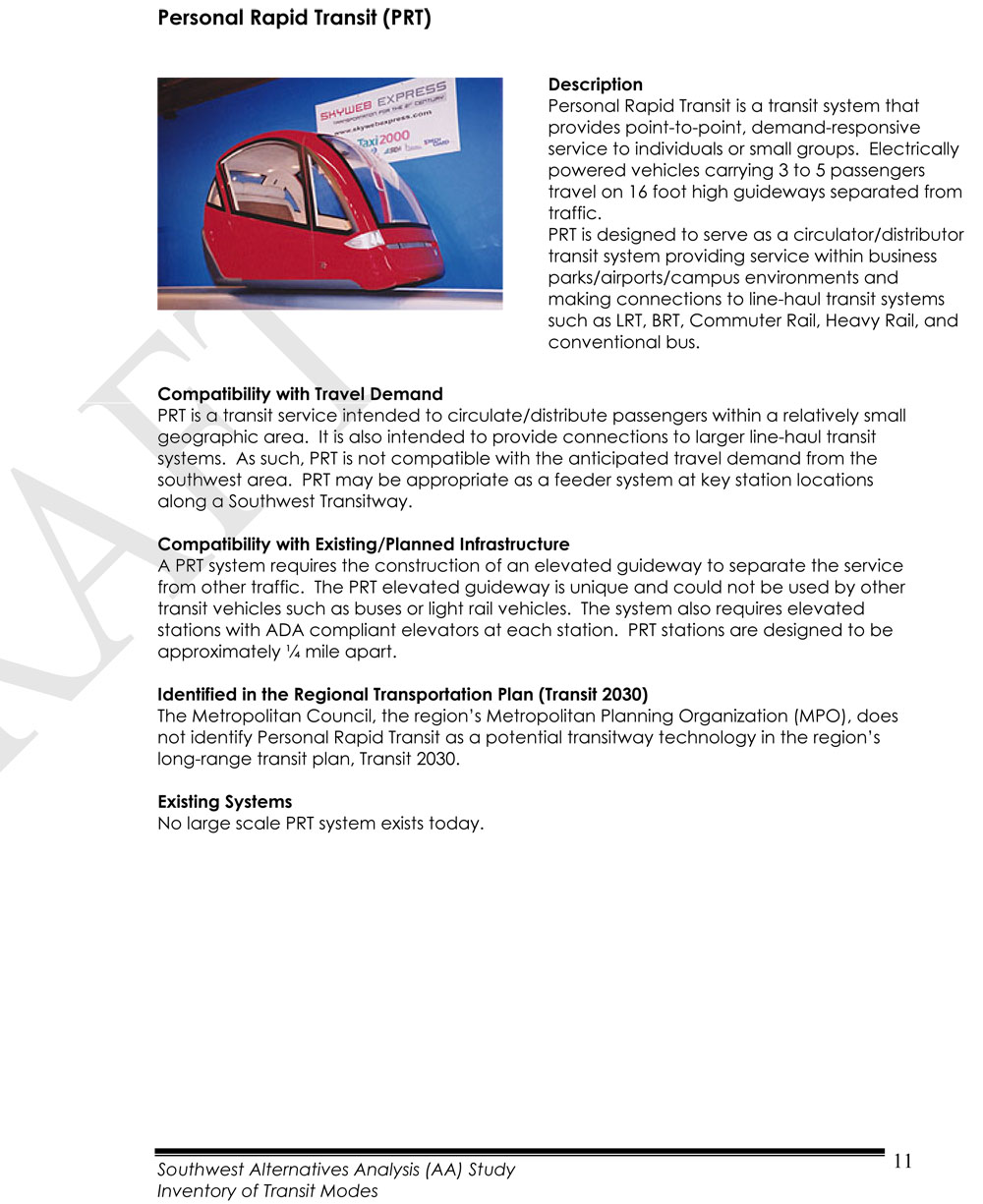
Here's the page that used to be on a PDF available on the SW corridor website (click to make it bigger):


Read about recent Personal Rapid Transit flops and fiascos HERE.

Thursday, August 25, 2011

PRT Hucksters Crank Up the Hype on Heathrow Pods

After a loooong wait and several delayed launches, the glorified golf carts at Heathrow are getting evaluated by... Twitter?


We'll it's not exactly "pod fever". And not all tweets are happy tweets:


Heathrow's ULTra Pods apparently have a 5% Failure Rate.

After many attempts over the years and hundreds of millions of dollars spent on studies, research and development, there are no true PRT systems in operation anywhere in the world. The pod project at Heathrow is supposed to be PRT, but it lacks the essential features of a true PRT system - multiple offline, elevated stations, lightweight pods and a slim, one-way guideway.

There really isn't much difference between the ULTra pod project at Heathrow and a nearly identical project in 1997 at Schiphol Airport. So what's the big deal?

Here's a 2002 video of automated pods in action:


Read about recent Personal Rapid Transit flops and fiascos HERE.

Sunday, August 21, 2011

Talking Points Memo Falls for Personal Rapid Transit Hype

Sad to see a great website like Talking Points Memo publish a poorly-researched puff piece about the glorified golf carts of Heathrow. And Josh Marshall, usually a sensible, smart guy embarassed himself by tweeting:


Forget Michele Bachmann sponsored legislation for Personal Rapid Transit boondoggle.

Forget that the debut of the ULTra pods at Heathrow was delayed a bunch of times.

Forget that the crummy pod car design that ULTra is based on had an almost identical debut in 1997 at Schiphol Airport.

Forget that ULTra has all kinds of bogus stuff on their website like these goofy plans for PRT projects in Minnesota.

Forget that the Heathrow pods have a 5% failure rate.

Nevermind that Heathrow pod ride is so bouncy and shaky, you will get seasick watching this video:


There's another video of a bumpy pod ride on this blog.

Nope, Josh Marshall says the pods are awesome.

Many years ago, I put something on my website called "THE MEDIA PRT TECHNO-PUFFERY HALL OF SHAME". But I could not keep up with the constant flood of PRT hype. This is what I wrote seven years ago:

The PRT publicity mill grinds out happy stories about PRT and the news media publishes them with little or no fact checking. The media likes to publish "Gee whiz" techno-puffery and for the most part, stories about rocket jet-packs and personal hovercraft don't do a lot of harm. PRT cleverly sneaks under the radar as a "Gee Whiz" story...but, of course there's a serious side to PRT . When PRT is revealed to be something that can cost taxpayers and investors a lot of money, the media just stops reporting ...I suspect out of embarrassment. Nobody wants to admit they were snookered, especially editors and publishers. All those hyped stories about PRT also create a false impression of PRT...and of course this creates a closed loop of information leading to even more cyber-hype and media techno-puffery.


Remember the embarrassing puff piece Salon did in 2004? Here's a Mark Olson explaining why PRT never goes anywhere in Minnesota:

Olson, who has been heading a PRT public relations campaign in Minnesota to drum up support, says public skepticism about new technologies is a big hurdle, as are established government relationships with existing transit manufacturers. "You have 40-plus years of relationship between our legislators and bureaucracies, and a flow of money between them," he says. "We're basically recreating the battle between horse-and-buggy manufacturers and the creators of the automobile."


Mark Olson was voted out of office after he was arrested and convicted of spousal abuse and is now a lobbyist for a PRT vendor with a $100 million project for Coon Rapids.

The Salon article provoked a lot of emails like this one:

Your article about Personal Rapid Transit was lacking in both context and perspective. The data on rail passenger-mile efficiency are not "skewed" by the success of the New York City subway or by scheduling that takes into account ridership patterns.

Further, the quote from Rep. Mark Olson does not even mention the battle in Minnesota over the highly politicized new (electric) light-rail line in Minneapolis. PRT has long been offered as an alternative to light rail in the Twin Cities by out-state Republicans who are against rail and in favor of more highways. This may be because PRT is currently in use exactly nowhere, and Minnesota Republicans expect and hope the status quo will continue in that respect.

Finally, your writer was evidently unable to find anyone who disagrees with the businesspeople/cheerleaders quoted in this piece. It's hard to believe that nobody has a question about PRT. Transit is a vitally important issue, but one-sided articles serve only to hinder informed discussion.


Maybe TPM will follow-up their PRT puff-piece with some of the well-researched muckraking TPM does best.

Read about recent Personal Rapid Transit flops and fiascos HERE.